People sometimes assume that milling logs for a home is a pretty straightforward job. You take a log, you run it through a machine, you stack it up, and somebody else builds a house out of it. I wish it were that simple. The truth is, a log home is only as good as the logs that go into it, and getting those logs right takes more decisions, more eyes, and more hands-on adjustment than most folks realize.
I've been milling and numbering logs for Merrimac Log Homes for years now, and I'd like to walk you through what actually happens between a tree being delivered to our yard and a numbered log being shipped to your build site. There's a lot of craft hidden in there.
It Starts with Reading the Log
Every log that comes across my mill is its own piece of wood. They're not interchangeable parts off a factory line. One might have a slight sweep to it. Another might have a knot cluster on one face. Another might have beautiful tight grain on one side and looser grain on the other. The first job, before the saw ever touches it, is to look at that log and figure out what it wants to be.
A log destined for a wall course needs to be straight enough to mill cleanly and stable enough to stay put once it's installed. A log meant for a feature spot, say, a long run beside a stone fireplace, or a header over a big front door, needs to have the character that's going to make that part of the home memorable. I spend real time deciding which logs go where in a home, because once that decision is made, everything downstream depends on it.
That kind of selection isn't something you can fully automate. You can program a saw to cut a profile, but you can't program judgment.
Milling the Profile
Once a log is selected and oriented, it goes through the mill to take its profile. At Merrimac we mill several profiles depending on what the homeowner wants (full round, D-log, square, hand-hewn looks), and each profile carries its own challenges. The cuts have to be clean, consistent, and dimensionally accurate so that when the home stacks up on site, every course sits flat and tight on the one below it.
The nuance here is that wood isn't metal. It moves. It has tension in it. A log that looks straight on the deck can release tension when you take a cut and bow slightly. Part of my job is anticipating that: knowing which way a particular species or a particular log is likely to move, and compensating before it becomes a problem at the build site.
I run my saws tight, I check my setup constantly, and I sight every log before it leaves the mill. If something doesn't look right, it doesn't move forward. We don't ship problems and let the builder figure it out.
Notches, Cuts, and the Tongue-and-Groove
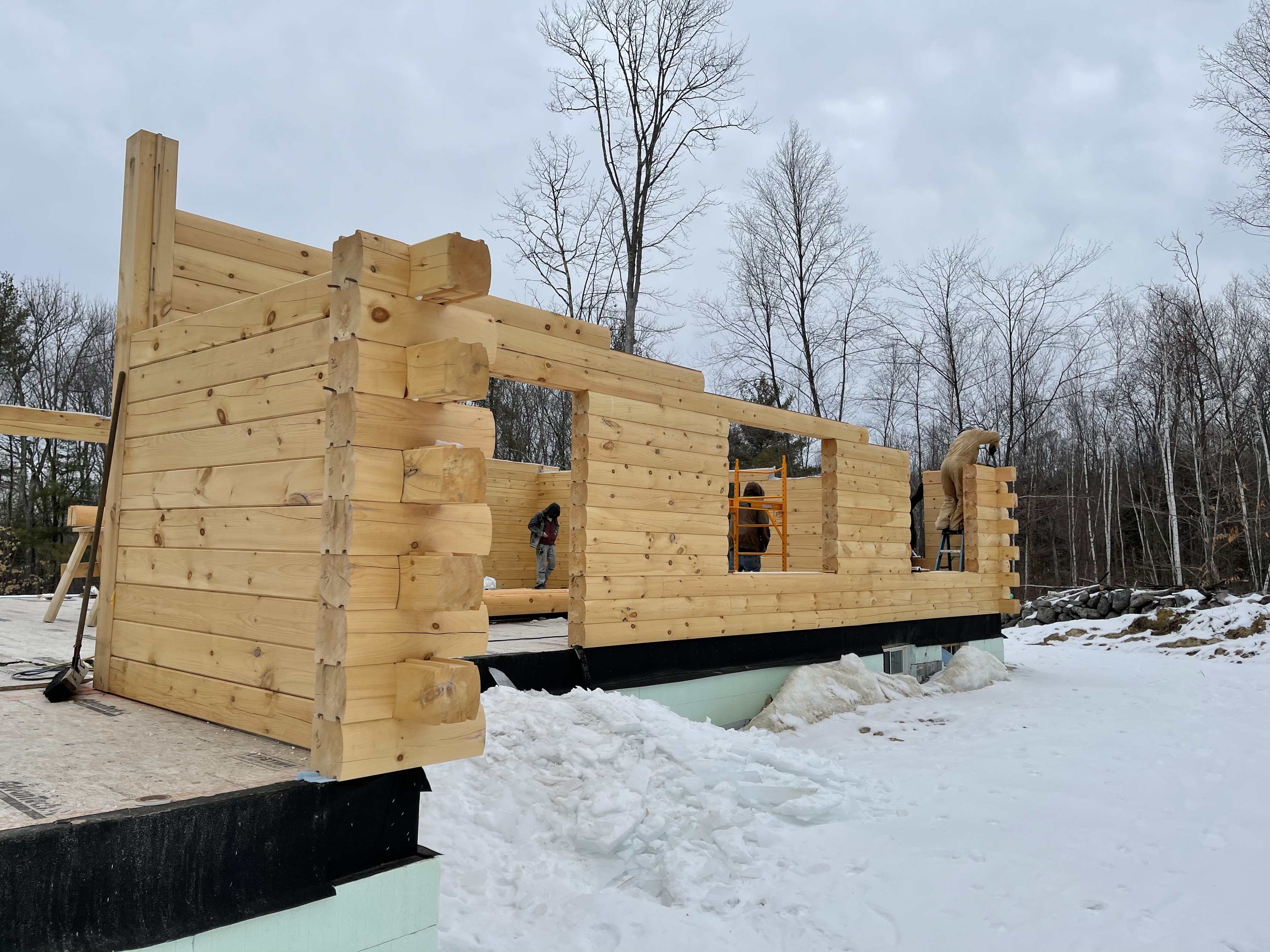
The profile is only the beginning. Each log also has to be cut for its specific spot in the home: corner notches, window and door bucks, tongue-and-groove edges where one log lays into the next, drilled passages for through-bolts and electrical chases. Every one of those cuts has to land in the right place, at the right depth, at the right angle.
The corner notches are where a lot of homes either look beautiful or look sloppy, and where a lot of energy efficiency is either won or lost. A tight, clean notch keeps weather out, keeps insulation working, and looks the way a log home is supposed to look. A loose notch is a problem you'll be chasing for the life of the house.
I take the time to dry-fit and check. I'd rather hold a log on the bench an extra five minutes than have a builder up on a wall figuring out why something doesn't sit right.
The Numbering System: Why It Matters More Than People Think
Once a log is milled, profiled, notched, and cut, it gets numbered. Every single log. This is the part of my job people understand the least, but it's one of the most important.
A log home isn't a pile of interchangeable lumber. Each log has been cut for a specific position in the home: first course, north wall, third log from the east corner, with a window buck cut at a particular spot. If that log ends up in the wrong place on site, none of the downstream logs will fit either. You can lose a day of build time chasing one mis-numbered log, and you can lose a lot more than that if the mistake doesn't get caught right away.
Our numbering system at MLH is built so the crew on the build site can read it like a map. Every log carries a code that tells the builder which wall it goes on, which course it belongs to, and which direction it faces. We cross-reference every numbered log against the home's stacking plan before it ever leaves the yard. By the time a kit hits your foundation, the assembly should feel like a puzzle where every piece is already labeled.
I take that part personally. If a log is numbered wrong, that's on me. So I check, and I check again, and then someone else checks behind me. Mistakes at the mill turn into headaches in the field, and headaches in the field turn into expensive headaches for the homeowner.
What I Try to Do Exceptionally Well at Merrimac
If you asked me what I bring to the job that I'm most proud of, I'd point to a few things.
The first is consistency. Whether we're milling a small cabin or a 5,000-square-foot custom home, every log gets the same attention. I don't have a "good enough for a small project" standard and a "really good for a big project" standard. There's just one standard, and it's the one I'd want for my own home.
The second is communication. I talk with the design team, with the builders, and when it makes sense, with the homeowners directly. If I see something in a plan that's going to be tricky to mill or assemble, I want to flag it before we cut a single log, not after. A lot of problems can be solved with a five-minute conversation up front.
The third is respect for the wood. Every tree that comes through here lived a long time before it became a log. I try to mill it in a way that honors what it is, leaving the character that makes a log home feel handmade while still hitting the precision a modern home needs to perform. Those two things aren't in conflict if you do the work right.
The Final Walk-Through
Before any home leaves our yard, I do a final walk-through of the package. I look at every numbered log, the stacking plan, the corners, the special-cut pieces, the package as a whole. If something doesn't sit right with me, I hold the load until it does.
That's the standard at Merrimac, and it's the standard I bring to the mill every day. A log home is going to stand for a hundred years or more. The least I can do is take the extra hour today to make sure it starts right.
If you have questions about how we mill, how we number, or how a log home actually comes together, I'm happy to talk.